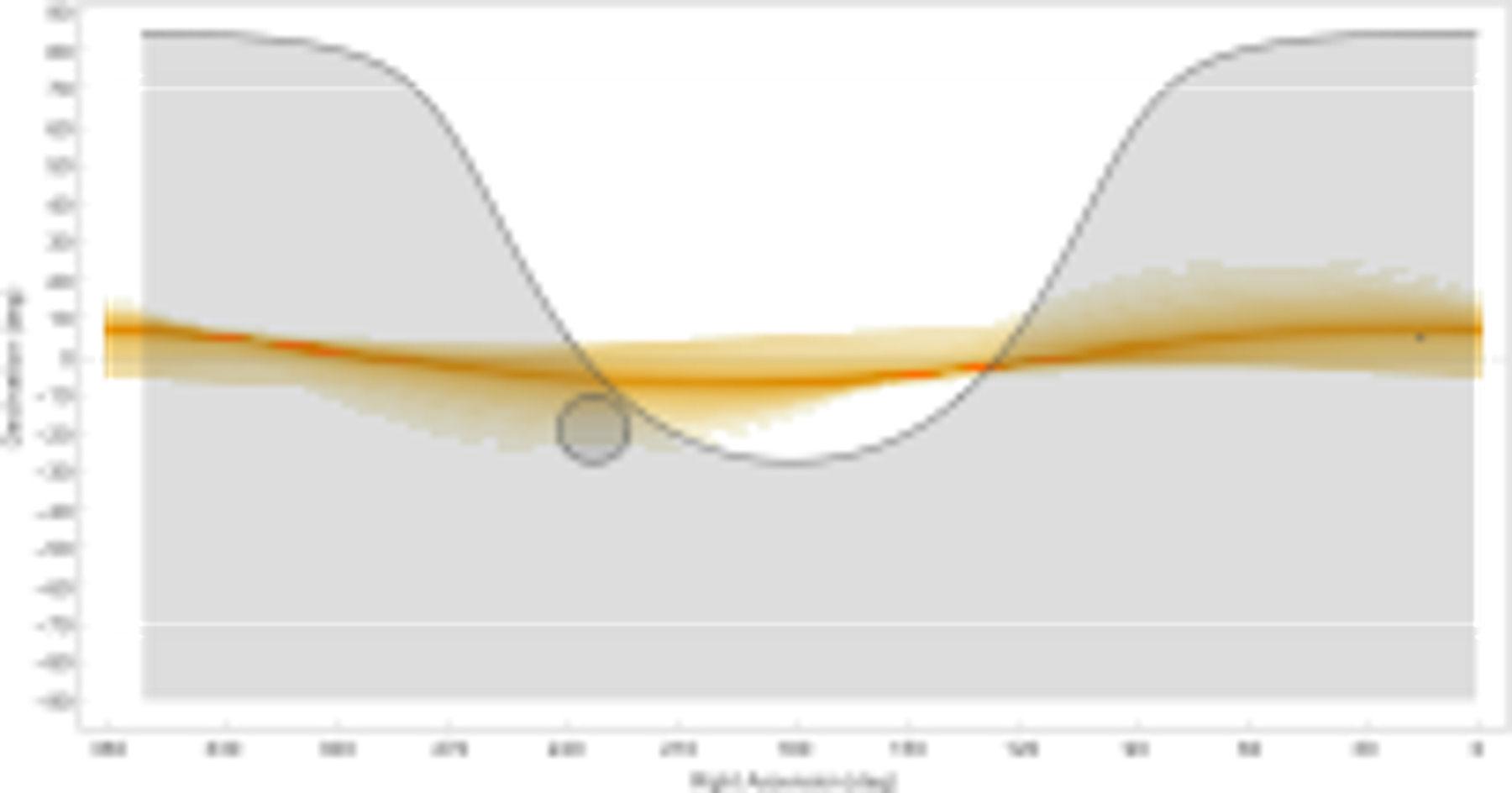
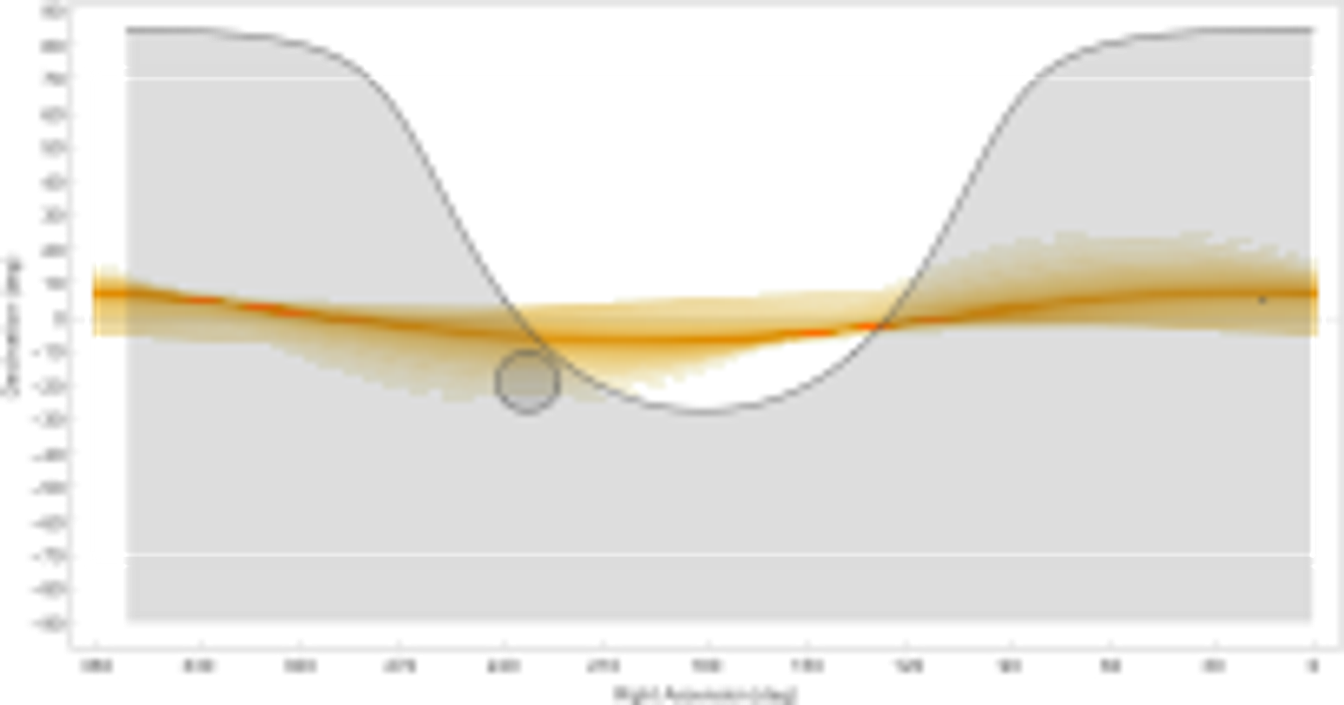
In the geostationary region (mean motion between 0.9 and 1.1 revolutions per day, eccentricity of 0.2 or less, and inclination of 70 degrees or less), breakups caused by the release of internal energy are considered the main cause of the growth of the space debris population. Among the fragments generated, those that periodically approach operational satellites need to be discovered. In this study, we combined a breakup model with an orbit propagation model. The breakup model describes the size, area-to-mass ratio, mass, and ejection velocity of fragments generated by a breakup. The orbit propagation model computes the orbits of artificial objects around the Earth. With these models, we predict the existence probability and the motion of the fragment cloud passing through any observation region at any time. Based on this prediction, we developed a method for the geostationary region that makes the search for unknown space debris more efficient.
We demonstrated that observation plans can be made qualitatively even when the scale and time of the breakup event are unknown. We also carried out follow-up observations and orbit determination of unknown space debris brighter than the detection limit of the optical telescope used in the study. These showed that the origin of the debris can be identified from its predicted motion across consecutive images. Furthermore, by stacking consecutive images according to the predicted motion of unknown space debris, we succeeded in detecting unknown space debris fainter than the detection limit of the optical telescope.