
In 1992, the US National Aeronautics and Space Administration (NASA) conducted an impact fragmentation experiment using a satellite built with 1960s technology, which relied heavily on metals. About 10% of the resulting fragments were recovered and analyzed. Based on these data, NASA published the NASA Standard Breakup Model in 2001, which describes fragments generated by collision-induced breakups. However, it has been reported that the NASA Standard Breakup Model cannot describe the characteristics of fragments generated in recent breakups. Examples include the anti-satellite weapon test that China conducted in January 2007 on an aging weather satellite, and the collision between the US communications satellite Iridium 33 and the Russian communications satellite Cosmos 2251 in February 2009. The reason was thought to involve fragments from composite materials, which are increasingly used to reduce weight; from solar array panels, which are deployed to supply sufficient power; and from multi-layer insulation, which covers the satellite surface to reduce radiative thermal coupling with space.
In this study, we conducted seven impact fragmentation experiments in total. We used small satellite models with a carbon fiber reinforced plastic (CFRP) plate as the primary structure, and small satellite models with solar array panels and multi-layer insulation. About 10,000 fragments were recovered and analyzed. In the area-to-mass ratio distribution of the fragments, fragments containing metal and fragments containing composites formed two independent peaks. In addition, fragments from the multi-layer insulation formed two further peaks, separate from the two peaks of the metal and composite fragments.
Low-velocity impact test facility
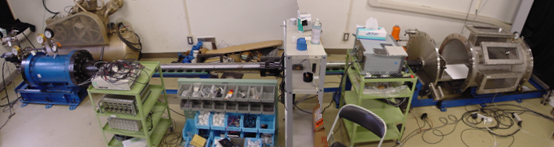
This is a single-stage air gun. It uses compressed air to launch metal spheres about 10 mm in diameter at speeds of up to about 300 m/s. This velocity range corresponds to impacts in geostationary orbit, where many important satellites operate. Even so, few low-velocity impact test facilities exist in Japan. Impact tests with this facility have therefore provided valuable data to researchers in Japan and abroad. The facility was also used for penetration strength tests of the sampler horn of the asteroid explorer Hayabusa.
Scattering of secondary debris generated by impacts
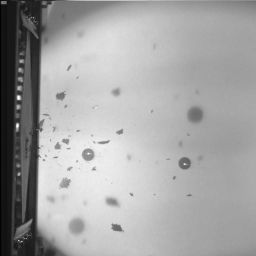
This study examines how secondary debris scatters when a metal sphere impacts a honeycomb sandwich panel (aluminum core with CFRP face sheets). Such panels are used for the reflectors of satellite parabolic antennas. Double exposure photography allows us to measure the velocity distribution of the projectile and of each piece of secondary debris.
Satellite breakup tests
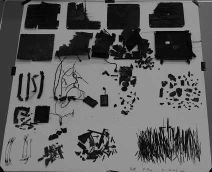
Many impact tests have been performed on simple plates, but impact tests on an entire satellite, including its onboard equipment, are rare worldwide. This is a high-speed camera image of a hypervelocity impact test on a mock satellite. The mock satellite is a 15 cm cubic housing that carries a battery, a CPU, a communication unit, a GPS receiver, and other components.
More than 1,500 fragments were recovered from the satellite, which was completely destroyed by the impact. Each fragment was classified and measured one by one, yielding data of great value worldwide. This impact test was carried out at the hypervelocity impact facility of the Computational Mechanics Laboratory (Akahoshi Laboratory), Kyushu Institute of Technology.