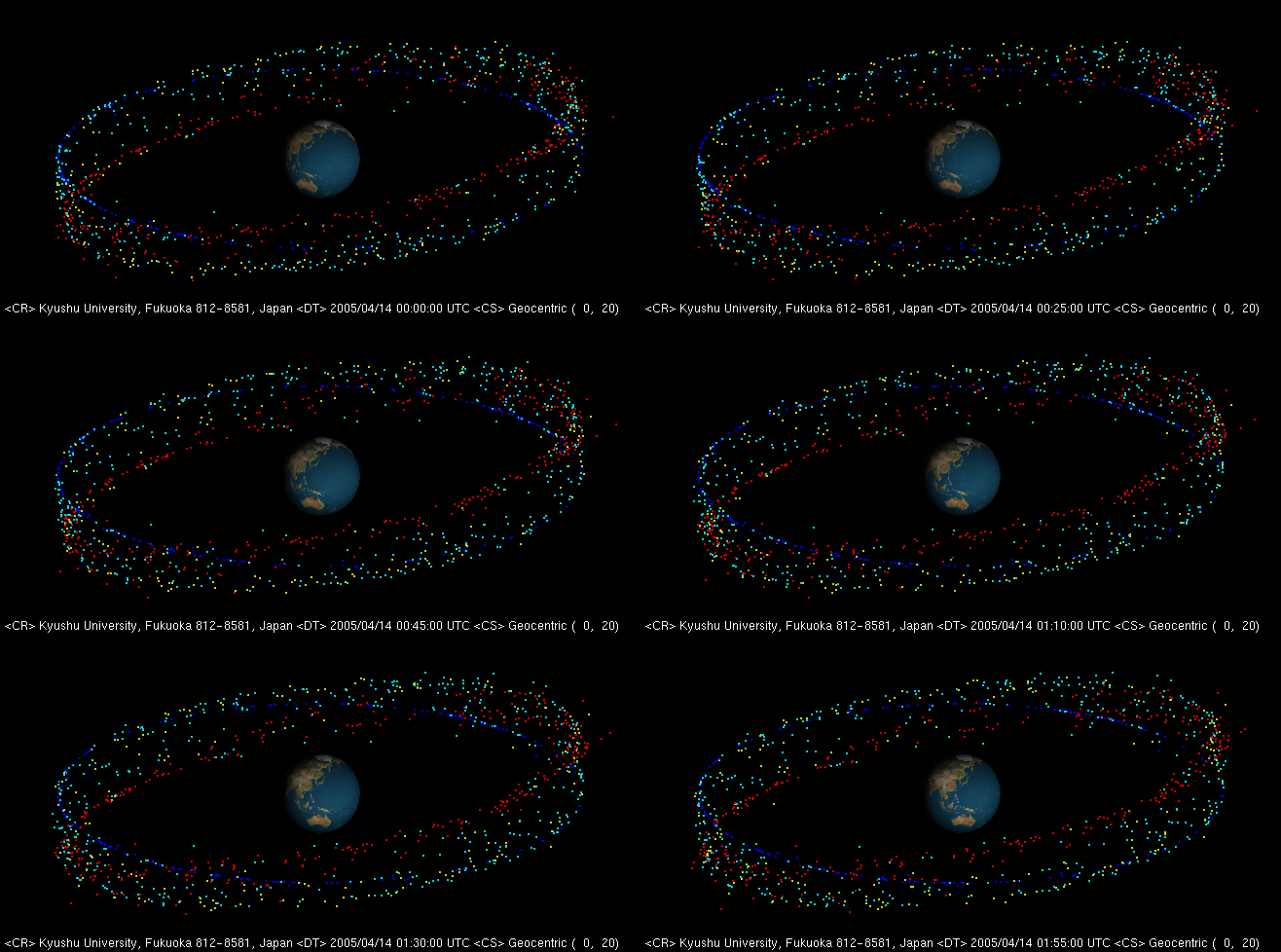
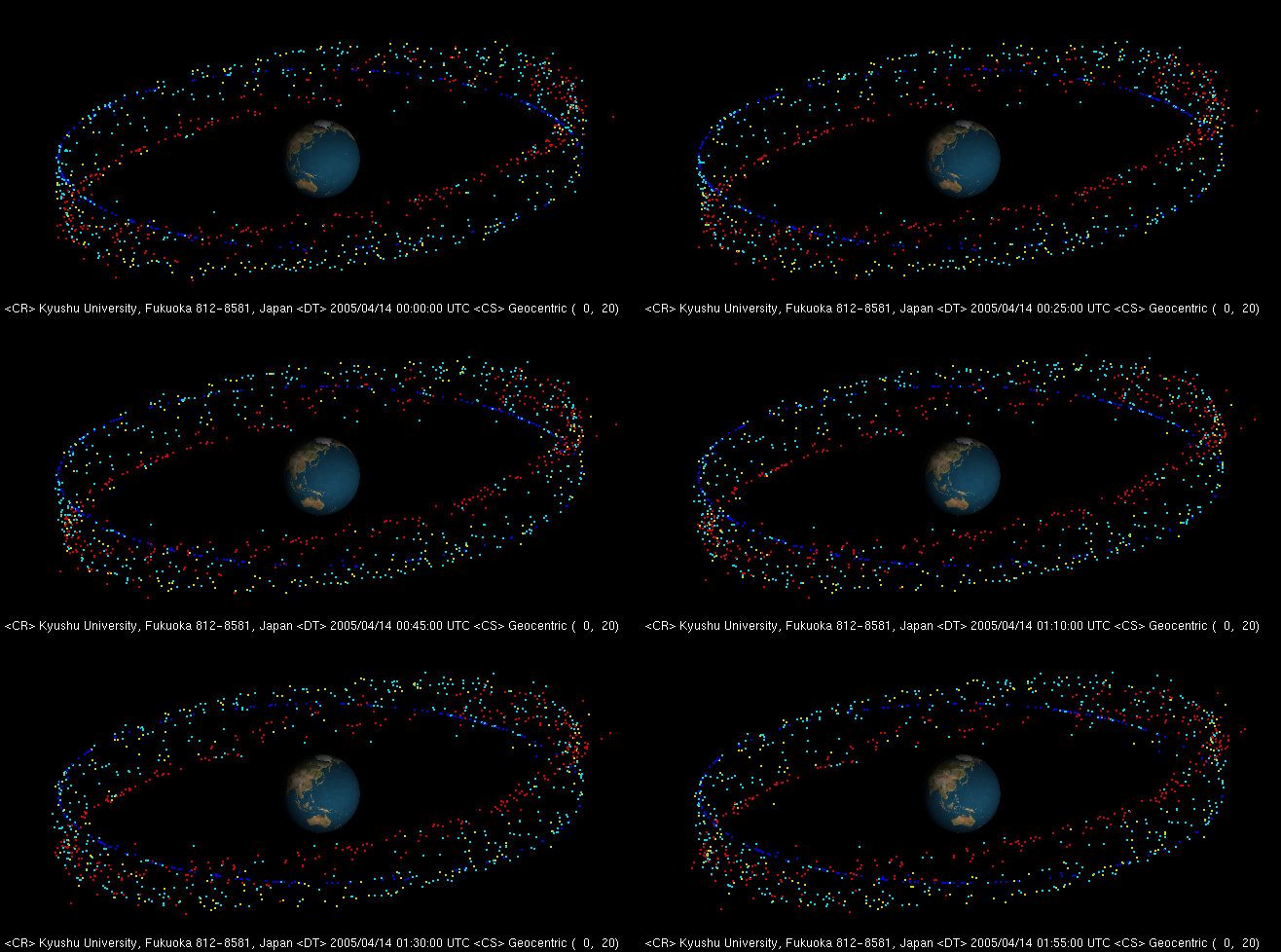
Discussions on preserving the orbital environment require a computational model that describes how the environment evolves over a long period, such as 50 to 100 years or more. In this study, we investigated the space debris environment in the geostationary region (mean motion between 0.9 and 1.1 revolutions per day, eccentricity of 0.1 or less, and inclination of 20 degrees or less) through both particle impact experiments and numerical simulations. Based on this work, we developed our own debris environment evolution model for the geostationary region (GEODEEM). For the space debris environment in low Earth orbit (LEO; altitude of 2,000 km or less), we developed a debris environment evolution model (LEODEEM) jointly with the Japan Aerospace Exploration Agency (JAXA).
By integrating GEODEEM and LEODEEM, we developed the Near-Earth Orbital Debris Environment Evolutionary Model (NEODEEM), which covers the entire Earth-orbiting debris environment. NEODEEM has been used in studies initiated by the Inter-Agency Space Debris Coordination Committee (IADC), such as “An Assessment of the Current LEO Debris Environment,” “Stability of the Future LEO Environment,” and “Benefits of Active Debris Removal in LEO.” It serves as Japan’s own space debris environment evolution model when Japan takes part in international discussions.