Photometric attitude estimation
 Light curve containing a glint
When a space object is observed optically from the ground, its brightness changes depending on its orbit, attitude, shape, and optical properties. It is known that the orbit, attitude, shape, and optical properties of a space object can therefore be estimated by using the time series of this brightness variation (the light curve) as the measurement. The measurement, a light curve, is a scalar quantity, whereas the state to be estimated is high-dimensional. This makes the problem a very difficult estimation problem.
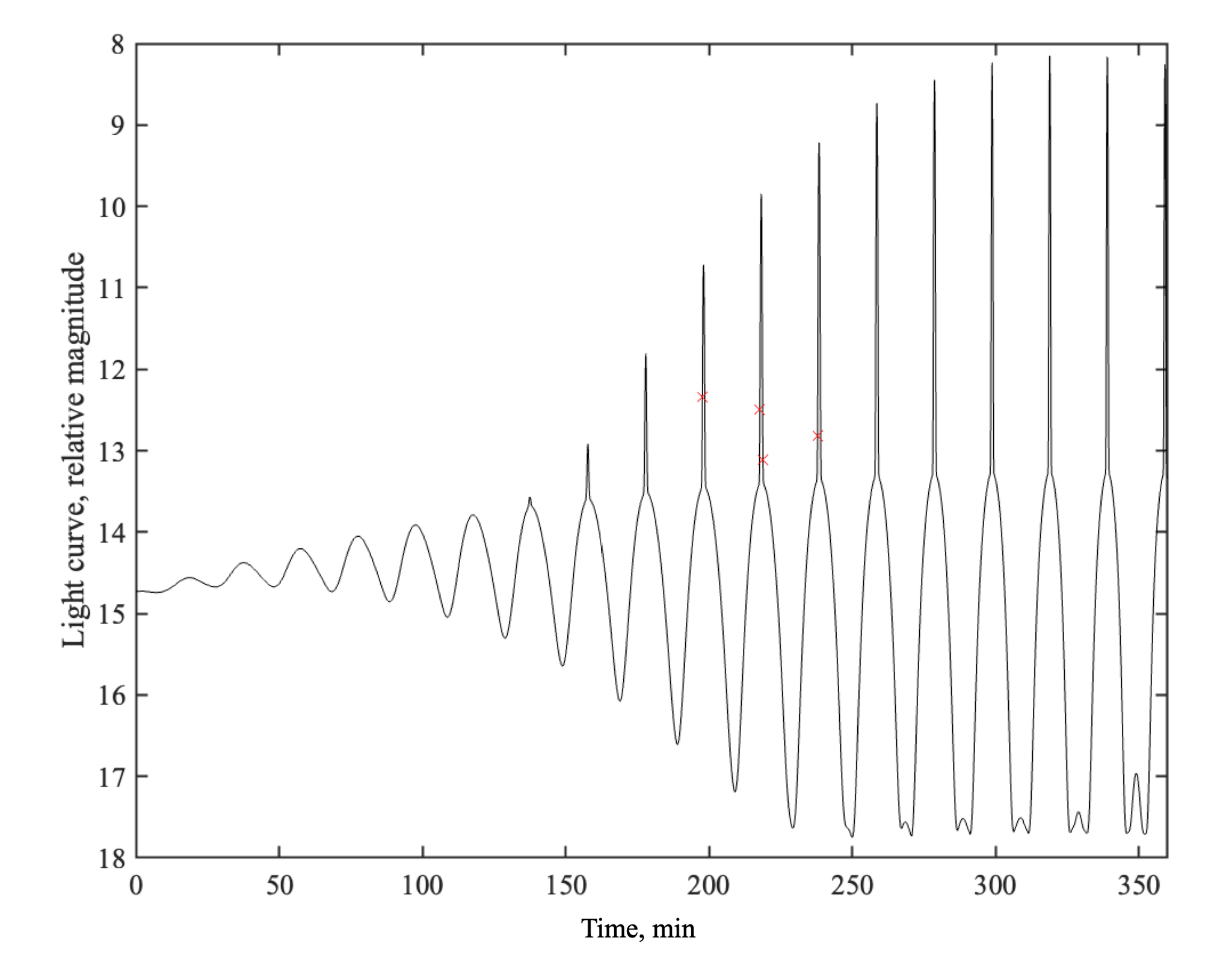
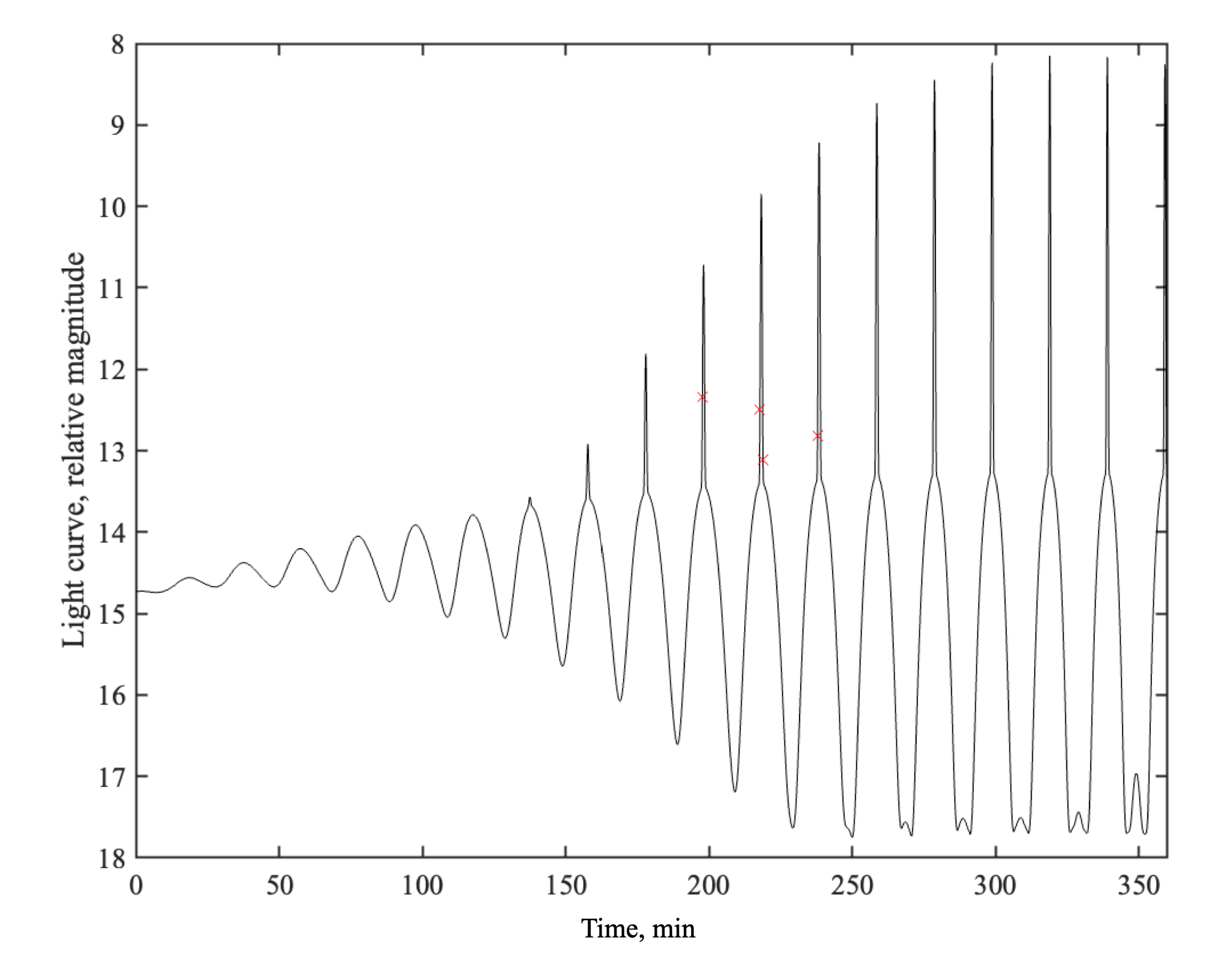
For this light-curve-based estimation problem, Matsushita et al. proposed a method that corrects the estimate using glints. A glint is a characteristic change in the light curve that occurs under specific geometric conditions. Because a glint is a sudden change in magnitude (the peak in the figure), the data around a glint carry more information on the attitude than usual. Specifically, when a glint is observed in the measurement update step of a Kalman filter, the method corrects the estimate and its covariance toward the attitudes at which a glint can occur. This is expected to make the estimate converge to the true value faster than estimation that does not explicitly account for glints.