Contactless attitude control
Space debris removal using lasers is being planned. Unlike methods that use a robotic arm or a tether, a laser can apply force and torque without contact. This ensures a high level of safety.
On the other hand, the physics of force generation imposes a constraint: force can be generated only in the direction normal to the laser-irradiated surface. To remove debris efficiently, the attitude of the debris must be stabilized. In addition, the direction of the attitude control torque is also constrained. We study attitude control laws under such torque direction constraints. For example, Sakai et al. noted that this constraint on the torque direction is similar to that of magnetic attitude control, and derived an attitude control method based on this similarity.
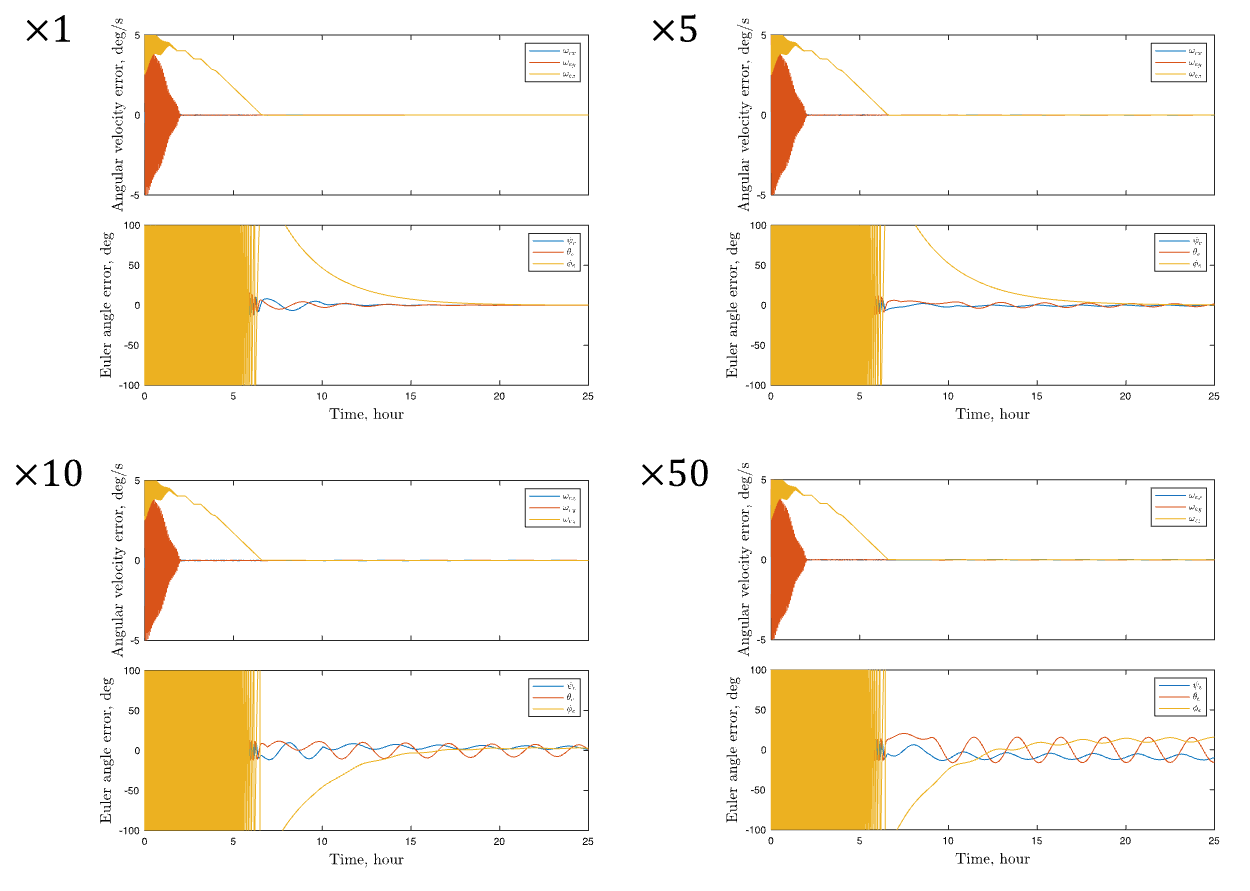
Focusing further on how to determine the control gains, Hayashibara et al. proposed a new attitude control method based on angular momentum feedback. Both the attitude error and the angular velocity error with respect to their targets are expressed in terms of angular momentum. This reduces the number of control gains and gives the threshold of effective control gains.
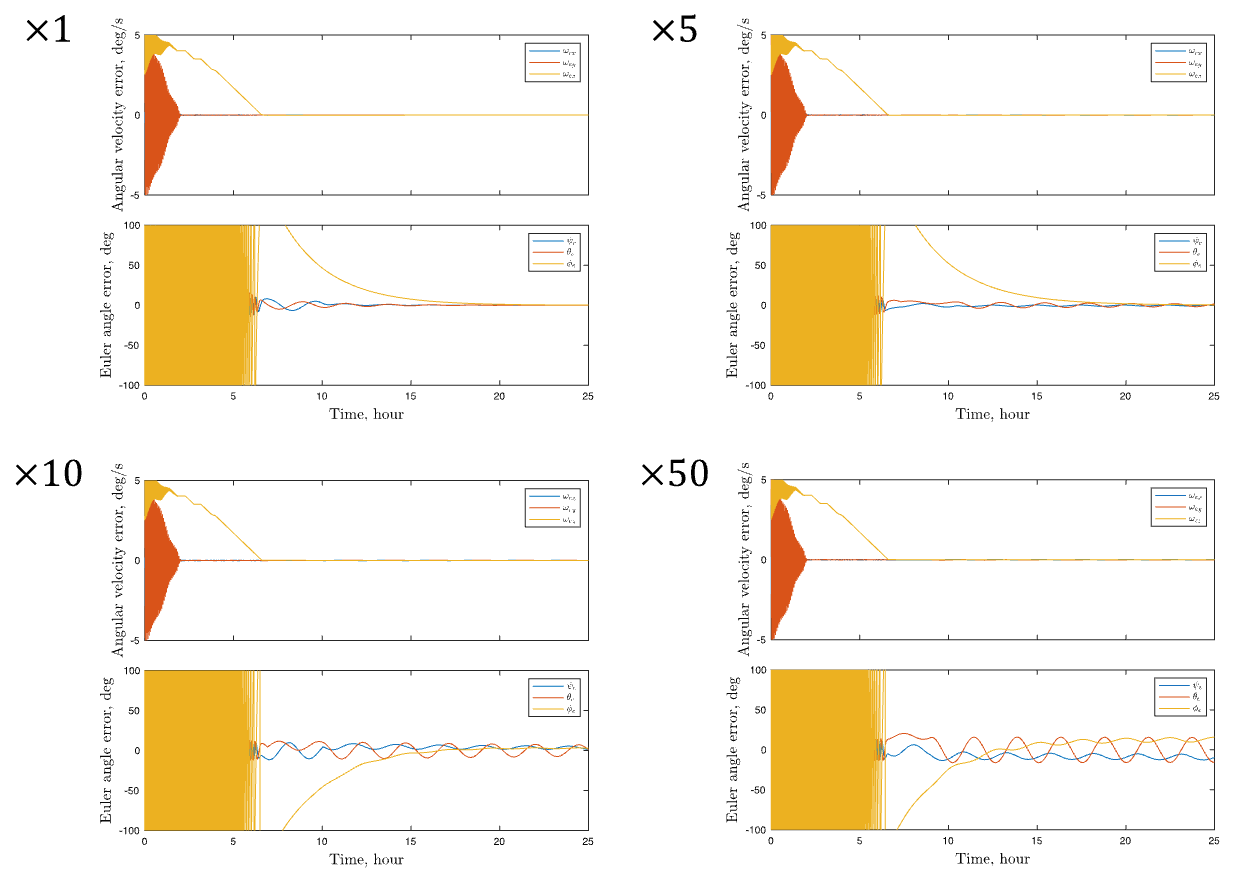 Difference in control performance for different control gains (x1 is the threshold of effective control gains)
Magnetic attitude control
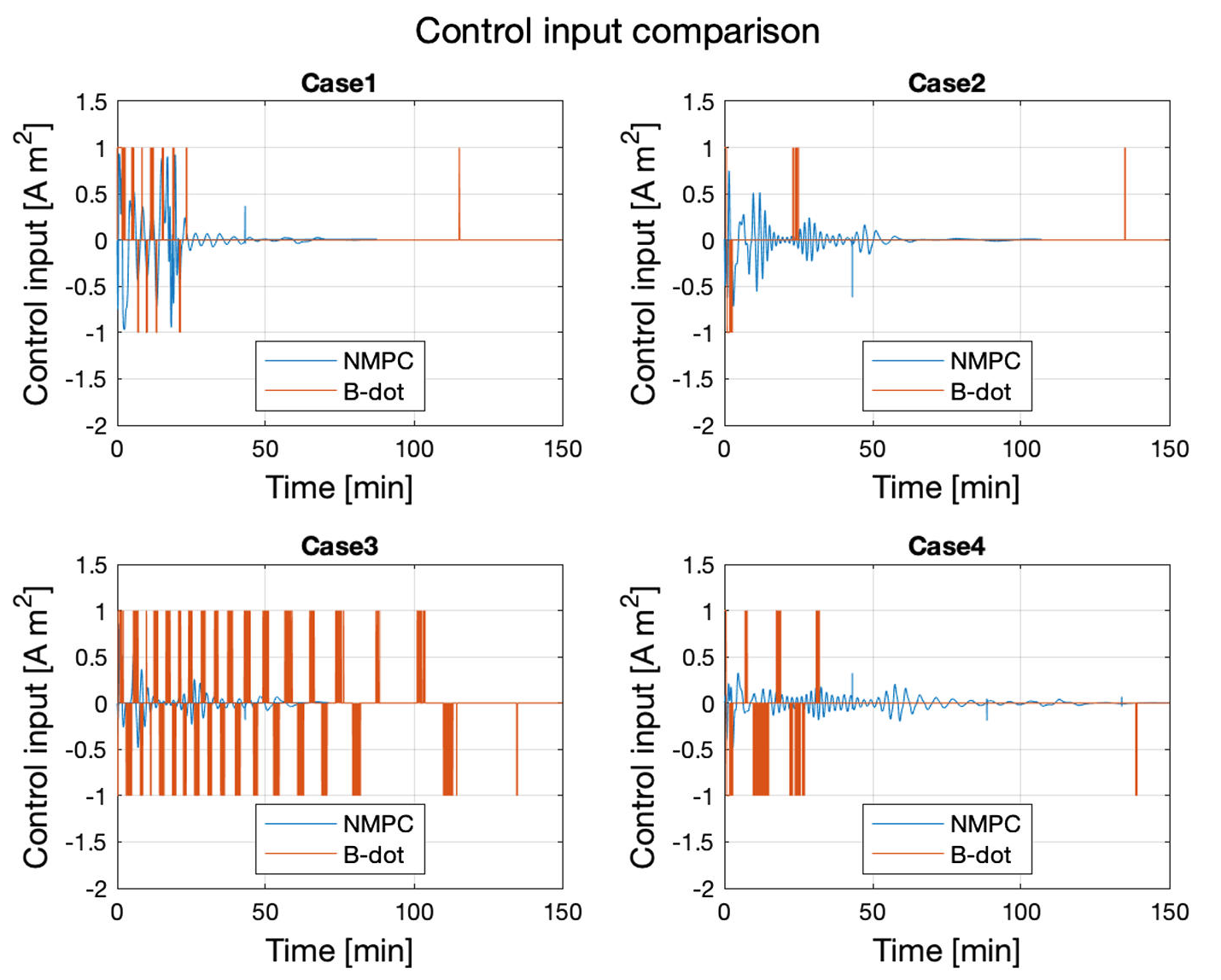 Comparison of control inputs between the conventional B-dot control law and the proposed method
Attitude control with magnetorquers requires no propellant, and the actuators themselves are small. For these reasons, it is widely used in nanosatellites. Magnetic torque is generated by interaction with the geomagnetic field, so the torque is always perpendicular to the geomagnetic field. As a result, the torque required for attitude control cannot be generated exactly in the desired direction (and magnitude). Magnetic attitude control is therefore inherently an underactuated system.
In addition to this inherent underactuation, we study attitude control using only a single magnetorquer. With a single magnetorquer, the magnetic moment that can be generated on the satellite is limited to one axis. Kondo et al. derived a control law for such a system using nonlinear model predictive control (NMPC).