
Formation Keeping Control for Deorbiting an Uncooperative Satellite by Laser Ablation
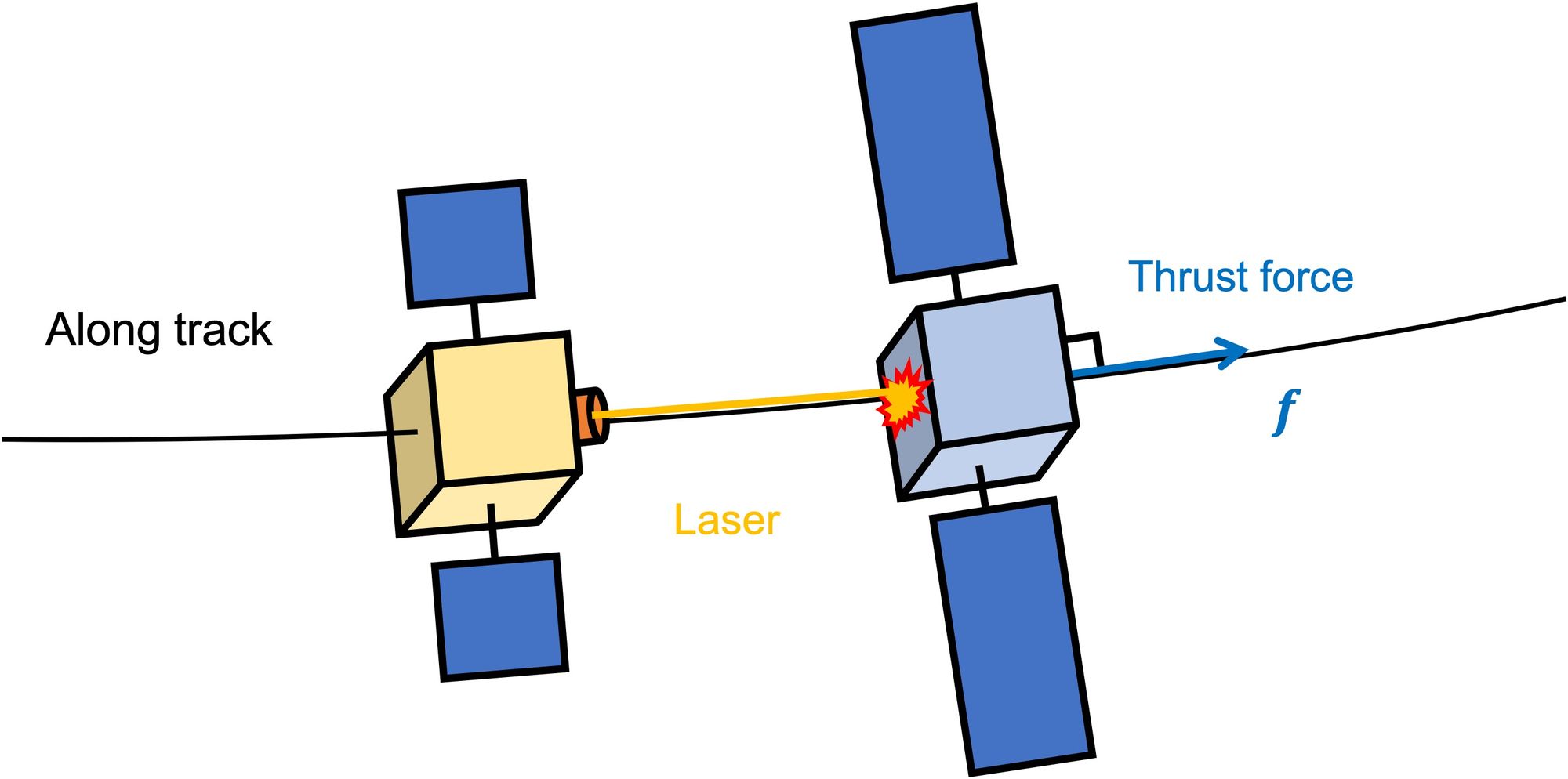
We study relative orbit design for space debris removal by a laser-equipped satellite.
In orbit, the laser-equipped satellite irradiates a debris object with laser pulses. The resulting ablation thrust lowers the orbit of the debris. During this process, the debris drifts away from the laser-equipped satellite. The satellite must therefore follow the debris using electric propulsion and maintain a relative orbit that allows laser irradiation. For this purpose, we proposed a relative orbit control method using relative orbital elements (ROE) [1].
Adaptive Relative Orbit Control
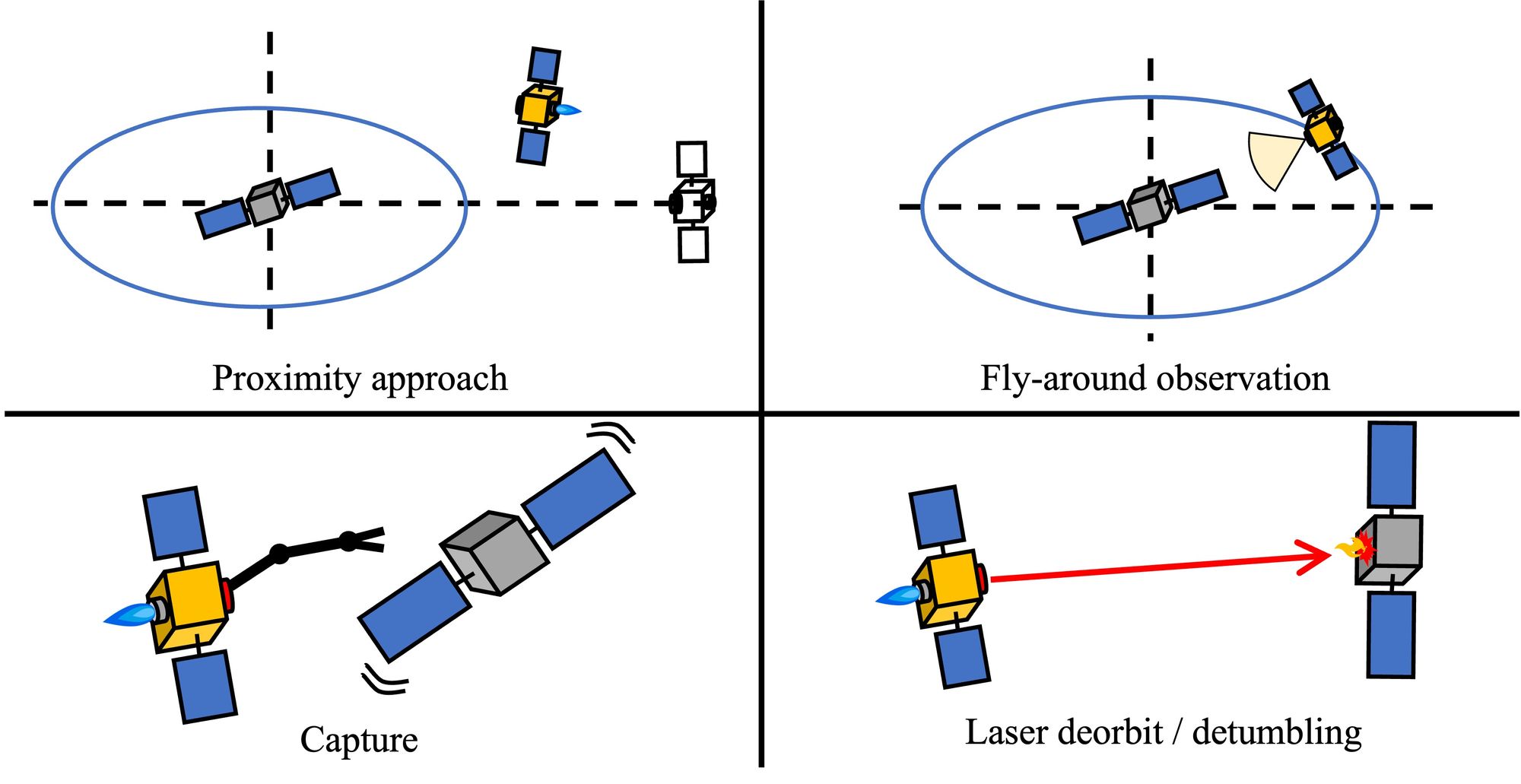
In active debris removal (ADR) in low Earth orbit, the atmospheric drag acting on the laser-equipped satellite differs from that acting on the debris (differential drag). As a result, the relative position of the two deviates from the planned one. Control that compensates for the drag can address this, but the atmospheric density is uncertain. The uncertainty of the laser ablation thrust must also be considered. We therefore estimate both uncertainties with sparse Gaussian process regression. Using this estimate, we proposed a method that adaptively controls the relative orbit against the uncertainty in the atmospheric density or in the laser ablation [2].
keywords: Relative Motion, Formation Flying, Control, Space Debris
ref.
- Isobe, S., Yoshimura, Y., Hanada, T., Itaya, Y., Fukushima, T., Formation Keeping Control for Deorbiting an Uncooperative Satellite by Laser Ablation, Advances in Space Research, Vol. 74, No. 4, 2024.
- Isobe, S., Yoshimura, Y., Hanada, T., Itaya, Y., Fukushima, T., Adaptive Relative Orbit Control Considering Laser Ablation Uncertainty, Journal of Space Safety Engineering, Vol. 11, No. 3, 2024.