VIDEO
Japanese subtitles available.
Observability-aware estimation and covariance-steering guidance for angles-only relative
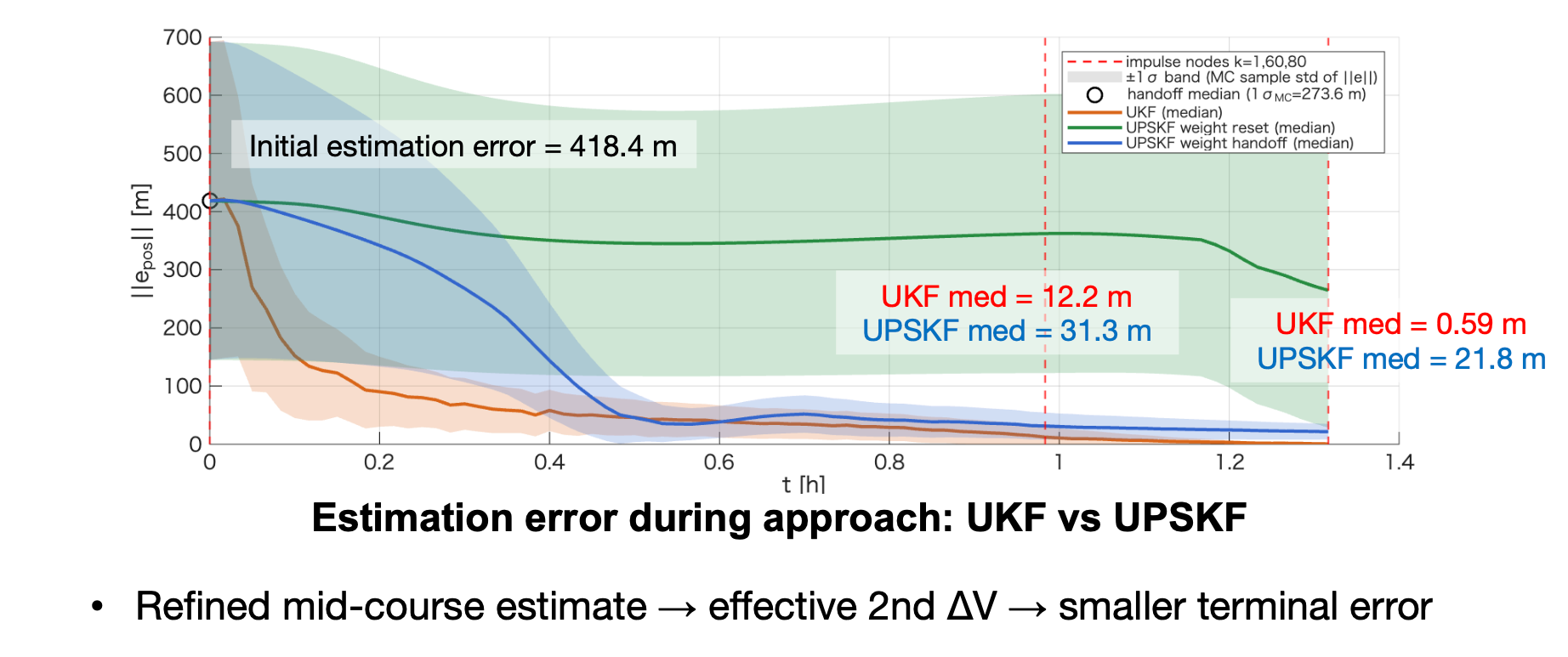
Approaching a non-cooperative object in geostationary orbit (GEO), such as a failed satellite or a piece of debris, requires accurate knowledge of its position relative to the chaser. This study proposes a two-phase method that estimates the relative orbit using only the direction to the target measured by an optical camera (angles-only observation), and then uses that result to approach safely. Because angles alone cannot determine range in principle, the first phase observes the target while passively drifting for several days and estimates the state with a filter (UPSKF) that adjusts the strength of each update according to how much information (Fisher information) has accumulated. Using relative modified equinoctial elements (RMEE), which remain non-singular near circular, equatorial orbits, improves both accuracy and robustness over conventional relative orbital elements, reducing the median position error from 16.3 km to 0.70 km. In the second phase, the estimate and its uncertainty are handed directly to a covariance-steering controller, which moves the chaser to a stand-off point 2 km away while probabilistically avoiding a 100-m keep-out zone. The terminal position dispersion is held to about 66 m. Future work will address closed-loop design using the estimated state rather than the true state.
← Back to list