VIDEO
Japanese subtitles available.
Adaptive Relative Orbit Control for Spacecraft Utilizing Electric Propulsion under Uncertain Disturbances, Yuu Tsurusaki, Yasuhiro Yoshimura, Toshiya Hanada, Yuki Itaya, and Tadanori Fukushima
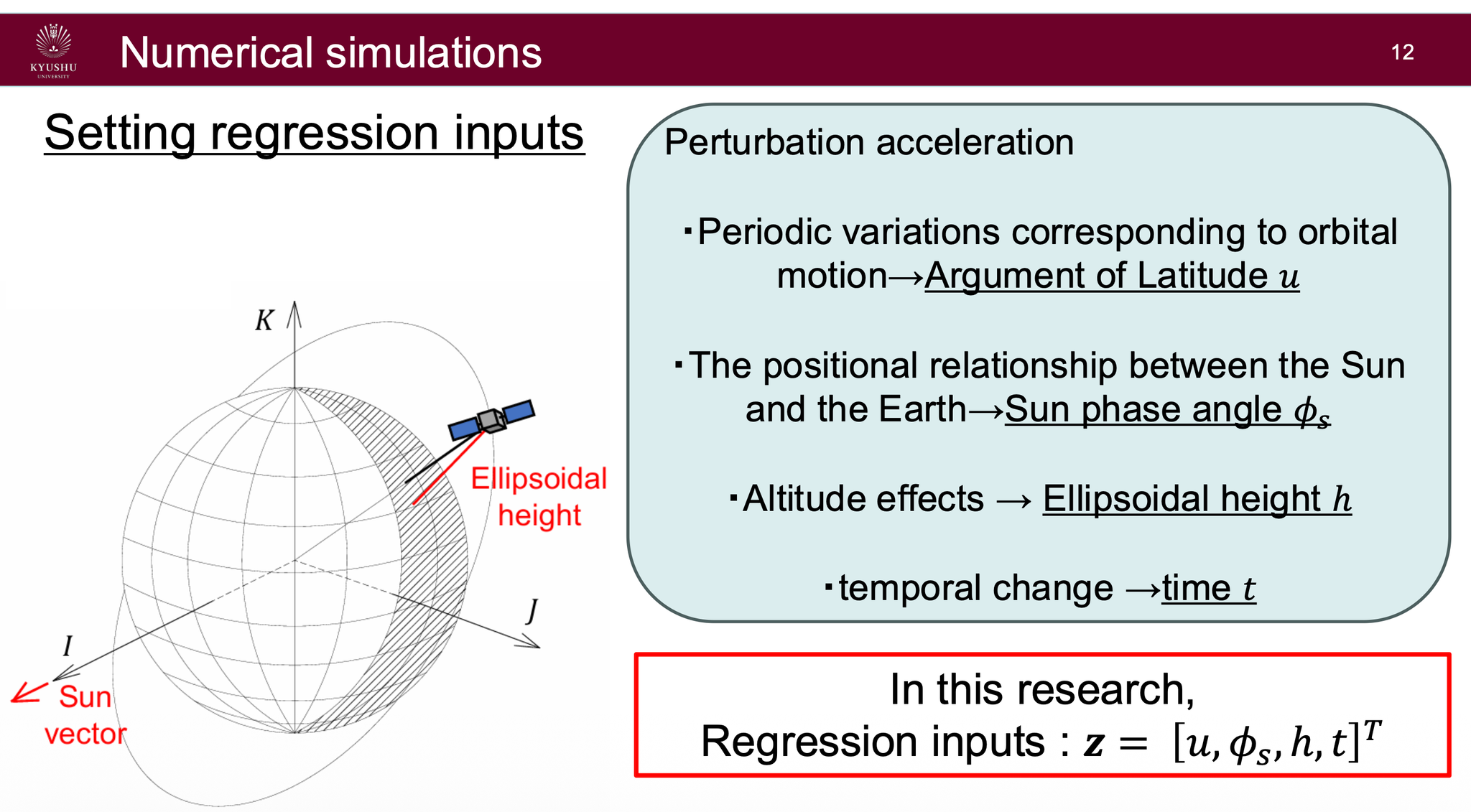
This paper proposes a high-precision relative orbit control method for active debris removal missions. In such missions, the target debris is non-cooperative, and its physical properties such as mass and shape are uncertain, while disturbances like atmospheric drag cannot be modeled accurately. In addition, electric propulsion systems can generate thrust only in an ON/OFF manner, which makes it difficult to directly apply conventional continuous control laws. To address these challenges, the proposed approach combines model reference adaptive control with machine learning, enabling unknown disturbances to be learned and compensated online while forcing the spacecraft motion to follow an ideal reference model. The continuous control input computed by the controller is further converted into ON/OFF thrust commands using pulse width pulse frequency modulation, allowing realistic actuator constraints to be considered. Numerical simulations demonstrate that, as learning progresses, the effect of disturbances is effectively suppressed and the relative position error converges to within approximately 0.5 m, confirming the effectiveness of the proposed method under uncertain conditions.
← Back to list